
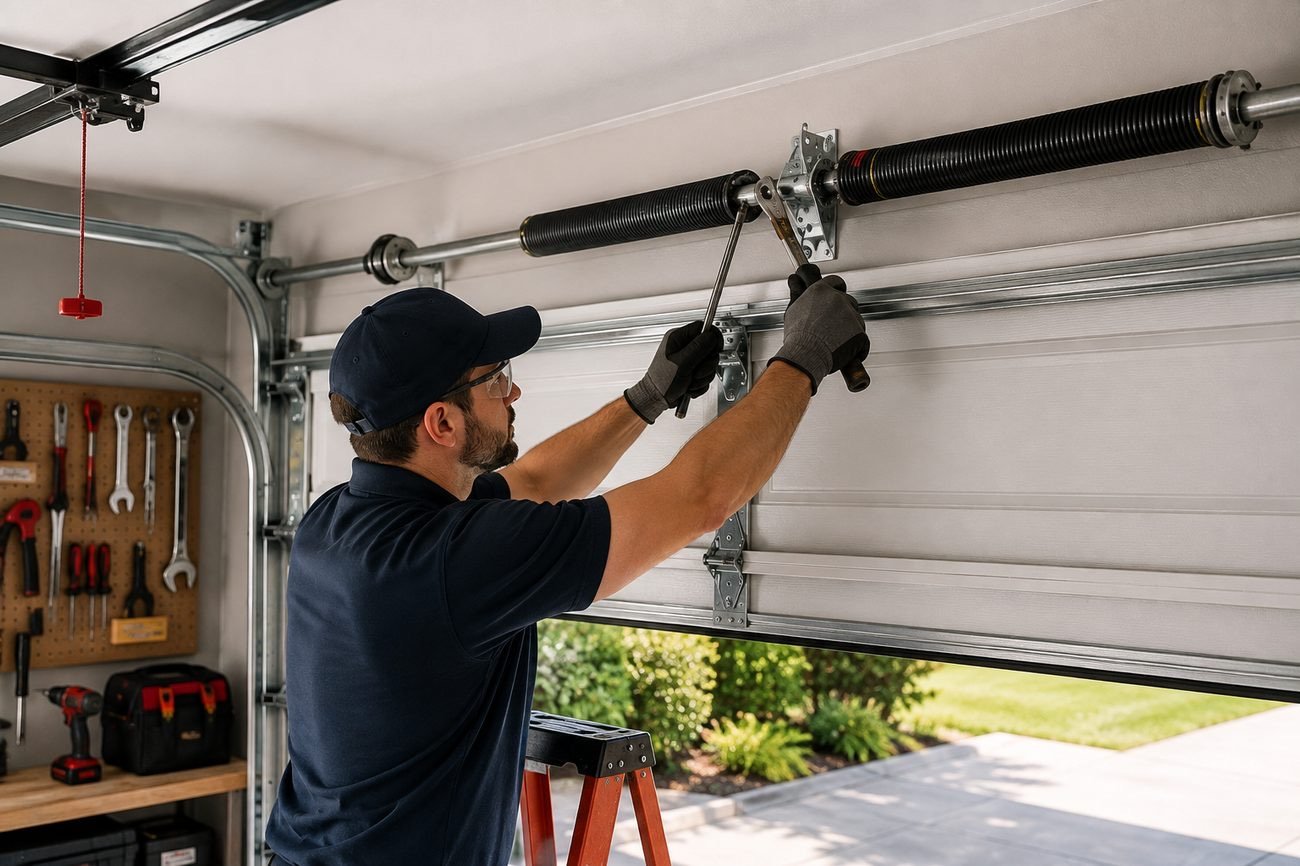
Garage door spring lifespan is one of the most common questions we get from homeowners around Garfield Heights, and the honest answer is that it depends on cycles, heat and how well your door is balanced. Most springs are rated for a set number of open-and-close cycles, and Ohio's weather—humid summers, cold winters and plenty of freeze-thaw—puts extra stress on the metal. In this article, we'll walk through what a cycle is, why heat matters, how a balanced door can add years to your springs, and when it's time to schedule replacement.
What Garage Door Springs Do and Why They Wear Out
Garage door springs counterbalance the weight of your door. A single-car door can weigh 130 to 200 pounds, and a double-car door can run 250 pounds or more. Without springs, you'd be lifting that weight by hand every time you leave the house. The springs store energy as the door closes and release it as the door opens, so the opener only has to nudge the door along.
Every time the door goes up or down, the spring flexes. That flex is called a cycle, and it's the main measure of spring life. A standard torsion spring might be rated for 10,000 cycles; a high-cycle spring might be rated for 20,000 or more. If your household opens and closes the door four times a day, that's about 1,460 cycles a year. At that rate, a 10,000-cycle spring could last roughly seven years—but many Ohio homes see more use than that, especially with kids, pets and deliveries.
Springs don't last forever, and they don't fail gracefully. When a spring breaks, it usually makes a loud bang and leaves the door too heavy to lift safely. That's why we tell homeowners to treat spring replacement as routine maintenance, not a surprise emergency. If you're not sure how old your springs are, a maintenance and tune-up can help you get a baseline.
Fast local service across Garfield Heights and Greater Cleveland — free written estimate before any work.
Cycles: The Number That Actually Matters
Manufacturers rate springs in cycles, not years. A cycle is one full open and close. The rating assumes the spring is properly installed, the door is balanced and the spring isn't overloaded. In real life, several things shorten that rating:
- Daily use: A family that comes and goes five or six times a day will wear out springs faster than a household that uses the door twice a day.
- Door weight: Heavier doors—wood, insulated steel, glass-panel—put more load on the springs.
- Improper installation: A spring wound to the wrong tension wears out prematurely and can damage the opener.
- Lack of lubrication: Dry springs and hinges create friction, which adds stress.
- Corrosion: Ohio road salt and humidity can rust springs, especially on doors that face the street.
If you want a rough estimate, count how many times your door opens and closes on a typical weekday, multiply by 365, and divide your spring's cycle rating by that number. That gives you a ballpark lifespan in years. For a busy household in Cleveland or Shaker Heights, a standard spring might last five to seven years; a low-use household might get ten or more.
How Ohio Heat, Humidity and Cold Affect Spring Lifespan
Ohio's climate is hard on garage door hardware. Summers bring heat and humidity that can accelerate corrosion on steel springs and cables. Winters bring freeze-thaw cycles, road salt and grit that work their way into hinges and tracks. Spring and fall bring wide temperature swings—a 40-degree day followed by a 70-degree day—which causes metal to expand and contract.
Heat is a particular issue for springs in attached garages that aren't climate-controlled. A west-facing garage can get quite warm in July and August, and sustained heat can weaken the steel over time. Humidity does its part too: a thin film of moisture on a spring can lead to rust pitting, which creates stress points where cracks start.
Cold doesn't break springs directly, but it makes metal more brittle and thickens lubricants, so the door works harder in January than it does in May. If your door sounds louder or moves slower in winter, that's a sign the hardware is straining. A tune-up before winter is one of the cheapest ways to protect your springs. We also see more broken springs in the first cold snap of the year than at any other time, which is why we keep our 24/7 emergency repair line open.
Why a Balanced Door Makes Springs Last Longer
A balanced door is one where the springs carry the door's weight evenly through the whole travel. When a door is balanced, you can lift it halfway by hand and it stays there. When it's out of balance, the opener has to work harder, the springs take uneven loads, and everything wears faster.
Balance affects spring lifespan in a few ways. First, an unbalanced door puts extra stress on the springs at certain points in the travel, which can cause premature fatigue. Second, it puts strain on the opener, cables and rollers, and those failures can damage the springs indirectly. Third, an unbalanced door is a safety hazard—if a spring breaks, the door can come down hard.
We check balance on every tune-up. It's a quick test: disconnect the opener, lift the door halfway, and see if it stays put. If it drifts up or down, the springs need adjustment or replacement. Keeping the door balanced is one of the simplest things you can do to extend garage door spring lifespan, and it's part of why we recommend an annual tune-up for Ohio homes.
Signs Your Springs Are Nearing the End
Springs usually give some warning before they break, but not always. Here's what to watch for:
- The door feels heavy: If you have to lift hard to open it manually, the springs are losing tension.
- The opener strains: A door that opens slowly or hesitates is often a sign of weak springs.
- Visible gaps or stretch: On extension springs, look for a gap in the coils. On torsion springs, look for a gap between the coils when the door is closed.
- Loud bang: A broken spring usually makes a sharp report that sounds like a gunshot.
- The door won't open: If the opener runs but the door doesn't move, a broken spring is a likely culprit.
- Uneven door: If one side of the door sags, a spring or cable may have failed.
If you notice any of these, stop using the door and call a professional. Springs are under high tension, and trying to replace them yourself is dangerous. Our team handles garage door repair across Greater Cleveland, and we can tell you whether you need a spring replacement or a simpler fix.
Replacement Intervals and What to Expect
There's no single replacement interval that fits every home, but here's a practical guide for Ohio homeowners:
- Standard springs: Expect 7 to 10 years in a low-use household, 5 to 7 years in a busy one.
- High-cycle springs: These can last 12 to 15 years or more, depending on use.
- Doors with heavy use: If your door runs more than 10 times a day, consider high-cycle springs and plan on inspection every couple of years.
- Older homes: If you don't know the age of your springs, have them inspected. Many springs fail without warning after 10 years.
When it's time to replace, we recommend replacing both torsion springs at once if they're the same age. If one breaks, the other is usually close behind, and replacing them together saves you a second service call. Torsion spring replacement typically runs $250 to $450 depending on the door and spring type. We also check cables, rollers and the opener while we're there, because a new spring on worn hardware won't last as long as it should.
If your door is older and you're facing repeated repairs, it may be worth talking about garage door replacement or a new garage door installation. A new door comes with new springs, modern safety features and better insulation, which can make a real difference in a Cleveland winter.
How to Get More Life Out of Your Springs
You can't make springs last forever, but you can get more cycles out of them. Here's what we recommend:
- Lubricate twice a year. Use a garage-door-specific lubricant on springs, hinges, rollers and tracks. Don't use WD-40 as a long-term lubricant; it attracts dirt.
- Keep the door balanced. Have a professional check balance during an annual tune-up.
- Don't overload the door. Avoid hanging heavy items from the door or tracks.
- Watch for rust. If you see rust on springs or cables, address it early.
- Schedule a tune-up before winter. Cold weather is hard on hardware, and a pre-winter check can catch problems before they strand you.
If you'd like a professional opinion on your springs, call Red Oak Garage Door Service and Repair at (216) 395-1738 or request a free quote. We're family-owned, licensed and insured, and we've been serving Garfield Heights and the surrounding communities since 2009.
FAQ
How often should garage door springs be replaced in Ohio?
Most springs last 7 to 10 years in a typical Ohio household, but heavy use, heat and humidity can shorten that to 5 to 7 years. If your springs are more than 10 years old or you don't know their age, have them inspected.
Can I replace garage door springs myself?
No. Torsion springs are under extreme tension and can cause serious injury if handled incorrectly. Spring replacement requires special tools and training. Call a licensed technician for safe service.
Why do springs break more often in winter?
Cold makes metal more brittle and thickens lubricants, so the door works harder. The first cold snap often triggers failures in springs that were already weakened.
Does a garage door tune-up really extend spring life?
Yes. A tune-up includes lubrication, balance adjustment and a close inspection of springs and cables. Catching small issues early prevents premature wear and costly breakdowns.
What's the difference between torsion and extension springs?
Torsion springs mount above the door on a shaft and are more common on modern doors. Extension springs run along the sides. Both store energy, but torsion springs generally last longer and are safer when they fail.