
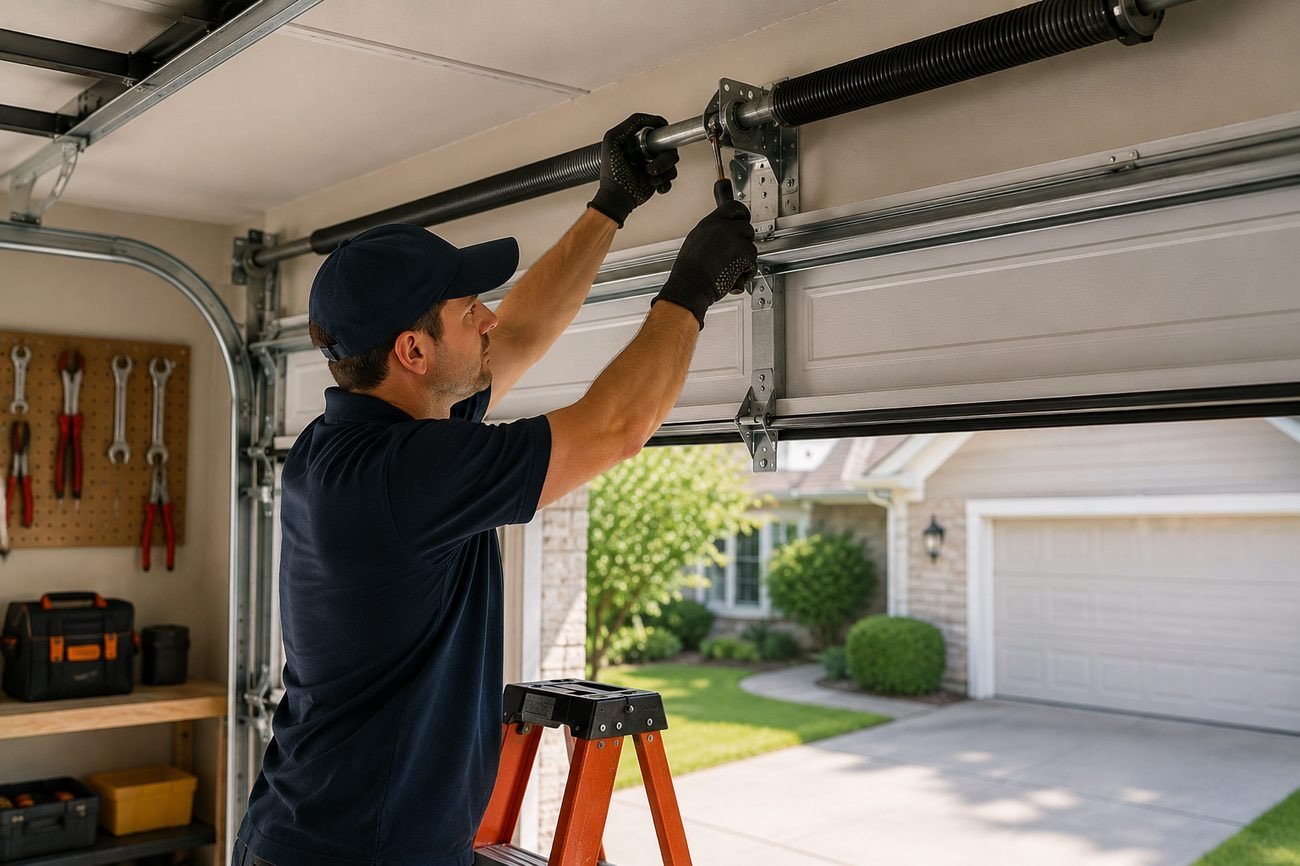
A garage door tune up is the cheapest insurance you can buy for the heaviest moving object in your house. A typical double-car door weighs 150 to 300 pounds, rides on torsion springs under extreme tension, and cycles up and down thousands of times a year. Skip the annual service and small problems—a dry roller, a loose bolt, a spring that's lost a little torque—turn into snapped cables, bent tracks, or a door that comes down hard. At Red Oak Garage Door Service and Repair, we've been running this same 21-point checklist on Garfield Heights and Greater Cleveland doors since 2009. Here's exactly what we look at, why it matters, and what a proper tune up prevents.
Why an annual garage door tune up matters in Ohio
Ohio weather is hard on garage doors. Summers bring humidity that works its way into hinges and rollers. Winters bring road salt that eats at bottom brackets and cables. And the freeze-thaw cycle in Northeast Ohio is brutal on the wood jambs and concrete aprons your door seals against. A door that runs fine in June can bind in January, and a binding door puts extra load on the opener and the springs.
Most garage door failures we see in Cleveland aren't random. They start as something small and predictable: a roller that stopped turning, a hinge that cracked, a spring that stretched a quarter inch. An annual tune up catches those things while they're still cheap to fix. Our maintenance and tune-ups start at $99, and that visit routinely saves homeowners the cost of a torsion spring replacement ($250–$450) or worse.
If your door is making new noises, running slow, or has started reversing for no reason, don't wait for the annual date. Call us at (216) 395-1738 or book a free quote and we'll get you on the schedule.
Fast local service across Garfield Heights and Greater Cleveland — free written estimate before any work.
What a proper garage door tune up covers
A tune up is not a quick squirt of lubricant. It's an inspection and adjustment process that touches every moving part on the door and the opener. The goal is twofold: find anything that's worn or failing, and return the door to the balance and alignment it had when it was installed. A door that's out of balance puts strain on the opener, wears the springs faster, and is a safety risk if a spring or cable lets go.
We break the work into three groups: the door itself (springs, cables, rollers, hinges, panels), the track and structure (alignment, fasteners, weather seal), and the opener and safety systems (force settings, travel limits, safety reverse, photo eyes). Every item below gets checked on every tune up visit.
The 21-point garage door tune up checklist
Here's the list our technicians work through, in order. If you're handy and want to do a visual pass yourself between professional visits, the items marked owner-safe are ones you can eyeball without tools. Anything involving springs, cables, or the opener's internal settings should be left to a technician—those parts store dangerous energy.
Springs, cables and balance
- Torsion spring condition (visual). Look for gaps, rust streaks, or a stretched coil. A spring that's sagging or has visible gaps is close to failing.
- Torsion spring tension check. We test lift force at several points in the travel to confirm the springs are still carrying the door's weight.
- Cable condition and drum wrap. Frayed strands, kinks, or cable that's jumped the drum are red flags. Cables work with the springs and fail together.
- Balance test. We disconnect the opener and lift the door halfway. A properly balanced door stays put. If it drifts down or slams up, the springs need adjustment or replacement.
- Bottom bracket and safety cable. The bottom bracket holds the most tension on the door. We check fasteners and confirm the safety cable is intact.
Rollers, hinges and panels
- Roller inspection. Nylon rollers should spin freely and feel smooth. Steel rollers should be quiet. Flat-spotted or seized rollers chew up the track.
- Hinge wear. Hinges crack at the knuckle over time. We check every hinge and replace any that are cracked, bent, or loose.
- Panel condition. Dents, cracks at the stile, and separation between sections are noted. A cracked panel can flex and bind.
- Fastener torque. We tighten hinge screws, bracket bolts, and track fasteners to spec. Loose hardware is the most common cause of rattling doors.
- Lubrication. A proper tune up includes lubricating hinges, rollers, and the torsion bar with a garage-door-rated lubricant—not WD-40.
Tracks and weather seal
- Vertical track plumb. We check that the vertical tracks are plumb and tight to the jamb.
- Horizontal track alignment. The curved and horizontal sections should be level and parallel. A bent track is usually a symptom, not the root cause.
- Track fasteners. Every lag bolt and bracket is checked. Missing or stripped fasteners get replaced.
- Bottom weather seal. The rubber seal at the bottom of the door keeps out water, snow, and pests. Cracked or torn seals get replaced.
- Side and top seals. We check the jamb seals and top seal for gaps that let in drafts and water.
Opener and safety systems
- Opener force settings. The opener's force adjustment should be set so the door opens and closes smoothly without straining.
- Travel limits. We confirm the door opens fully and closes flush to the floor, with no short-cycling.
- Safety reverse test (contact). We place a 2x4 flat on the floor under the door and confirm it reverses on contact. This is the single most important safety test on any automatic door.
- Photo-eye test. We break the beam between the two sensors and confirm the door reverses. We also check that the sensors are aligned, clean, and mounted at the right height.
- Manual release. The emergency release cord should work smoothly and be reachable.
- Opener hardware and light. We check the rail, chain or belt tension, and the light and battery backup if equipped.
That's the full 21. Most tune ups take under an hour, and we'll walk you through anything we find before we do any additional work.
The failures a tune up prevents: springs, rollers, balance and safety reverse
Four systems cause the majority of the emergency calls we run. Each one is covered by the checklist above, and each one is far cheaper to maintain than to repair after a failure.
Springs. Torsion springs are rated for a certain number of cycles—typically 10,000 for standard springs, more for high-cycle. A door that runs four times a day uses about 1,460 cycles a year. A spring that's been running with a slightly off-balance door wears faster than it should. When a torsion spring snaps, it's loud, it's sudden, and the door becomes dead weight. A tune up catches the warning signs—gap, rust, loss of lift—before that happens. A torsion spring replacement runs $250–$450; a tune up is $99.
Rollers and hinges. Seized rollers grind against the track, which wears the track and strains the opener. Cracked hinges flex and bind. Left alone, a $3 roller becomes a track replacement. We replace worn rollers and hinges during the tune up if needed.
Balance. An unbalanced door is a safety issue and an equipment issue. The opener has to work harder, the springs wear unevenly, and the door can drift open or slam shut. The balance test in item 4 catches it, and adjusting spring tension restores it.
Safety reverse. This is the one that matters most for families with kids and pets. The safety reverse system—both the contact reverse and the photo eyes—is what stops the door from closing on something in its path. It's also the system most likely to drift out of adjustment or get knocked out of alignment. We test both systems on every tune up. If your door fails either test, treat it as a repair, not a maintenance item—call us at (216) 395-1738 and we'll get it looked at promptly.
When to schedule your garage door tune up
Once a year is the standard recommendation. For most homeowners, fall is the best time—get the door ready before the freeze-thaw season and before you're relying on it to seal out cold air. Spring is the second-best window, especially if your door sat through a hard winter.
Schedule sooner if you notice any of these:
- The door is louder than it used to be, or rattles when it moves.
- It opens or closes unevenly, or looks crooked in the opening.
- The opener strains, or the door reverses before it reaches the floor.
- You've had a spring or cable repair in the past two years (the other side is often close behind).
- You can't remember the last time it was serviced.
We serve Garfield Heights, Maple Heights, Bedford, Parma, Cleveland, Shaker Heights, Solon, Strongsville, Westlake and the rest of Greater Cleveland. You can see the full list on our service area page. If you're not sure whether your door is due, send a photo to info@redoakgaragedoor.com or request a free quote and we'll tell you straight.
Our hours are Monday–Friday 7am–7pm and Saturday 8am–5pm, with a 24/7 emergency line for when something fails outside those hours. We're licensed and insured, family-owned since 2009, and we carry a 4.9-star average from 127+ local reviews. You can read some of them on our reviews page. If a tune up turns up a repair, we'll quote it before we start—no surprises.
DIY vs. professional: what you can and can't safely check
We're not going to tell you to never touch your door. There are a few things you can safely do between annual visits. You can visually inspect the springs for gaps and rust. You can look at the cables for fraying. You can test the safety reverse with a 2x4 (this is worth doing monthly—it takes 30 seconds). You can wipe down the photo eyes and confirm the indicator lights are on. You can listen for new noises.
What you shouldn't do: adjust torsion springs, replace cables, or open the opener housing to change force settings. Torsion springs store enough energy to cause serious injury, and the adjustment process requires specific tools and knowledge of the door's weight and spring wind. The same goes for cable replacement—a cable under tension can whip. If you find a problem in your visual check, call us. Our garage door repair service covers springs, cables, panels, rollers and tracks, and we'll tell you honestly whether it's a tune-up fix or a repair.
If your door is older and you're weighing repair against replacement, a tune up is a cheap way to get a professional opinion. We'll tell you what's serviceable and what's on its way out. If replacement makes more sense, we install new single-car steel doors from $1,200–$2,500 and double-car doors from $1,800–$5,000, with a 5-year workmanship warranty. You can see examples on our gallery page.
FAQ
How often should I get a garage door tune up?
Once a year for most homes. If your door cycles more than six times a day, or if you have an older door with standard-cycle springs, twice a year is worth considering. Fall is the most popular time in Northeast Ohio because it gets the door ready for winter.
How much does a garage door tune up cost?
Our tune-ups start at $99. That covers the 21-point inspection and standard adjustments. If we find worn parts—rollers, hinges, a weather seal—we'll quote those separately before doing the work. Spring and cable replacements are quoted as repairs.
Can a tune up fix a door that reverses before it hits the floor?
Sometimes. If the cause is a misaligned photo eye, dirty sensor lens, or an opener force setting that's too sensitive, a tune up can correct it. If the cause is a failing spring or a binding track, that's a repair. We diagnose it on the visit and tell you which it is before we start.
Do you service garage doors in my town?
We cover Garfield Heights and most of Greater Cleveland, including Maple Heights, Bedford, Bedford Heights, Warrensville Heights, Valley View, Parma, Seven Hills, Independence, Cleveland, Shaker Heights, Cleveland Heights, South Euclid, Beachwood, Solon, Mayfield Heights, Richmond Heights, Euclid, Brecksville, Broadview Heights, North Royalton, Twinsburg, Chagrin Falls, Brooklyn, Lakewood, Middleburg Heights, Berea, Strongsville, North Olmsted and Westlake. If you're not sure, call us or check the service area page.
What if my door breaks outside your regular hours?
We have a 24/7 emergency line. Call (216) 395-1738 and we'll schedule the earliest available appointment. We don't promise a specific arrival time, but we do prioritize emergency calls and get to them as fast as local scheduling allows.