
That Loud Bang Was Probably a Snapped Spring
If you were in the kitchen and heard a loud bang garage door noise that sounded like a gunshot or a heavy book hitting the floor, you're not imagining things. In most Northeast Ohio homes, that sound is a torsion spring breaking. The spring is under extreme tension, and when it fails, it releases that energy all at once. The door may still be closed, or it may be stuck halfway up. Either way, it's not safe to use.
At Red Oak Garage Door Service and Repair LLC, we've seen this hundreds of times since 2009. A snapped spring is the most common reason a garage door suddenly stops working after a loud noise. The good news: it's a straightforward repair for a trained technician, and you can usually get back to normal quickly. The bad news: until it's fixed, the door is a hazard, and there are a few things you should never do.
This article explains what happened, why the door is dangerous now, what to do (and not do) in the next few hours, and how fast you can expect a fix. If you need help right away, call (216) 395-1738.
Why a Snapped Spring Makes the Door Dangerous
Your garage door is heavy—often 150 to 300 pounds or more. The springs do the heavy lifting, not the opener. When a spring snaps, that counterbalance is gone. The door becomes dead weight. If it's open, it can come crashing down. If it's closed, it may be nearly impossible to lift manually, and forcing it can bend tracks, break hinges, or cause the door to fall off the tracks.
There's also the risk of injury. A broken spring can leave sharp, jagged ends. The cables that work with the spring can snap or whip. And if you try to open the door with a broken spring, the door can drop suddenly. That's why we tell homeowners: leave it alone until a technician arrives.
If you have a torsion spring system (the spring is mounted on a metal shaft above the door), the danger is even higher. Torsion springs store a lot of energy, and adjusting or replacing them requires special tools and training. This is not a DIY job.
Fast local service across Garfield Heights and Greater Cleveland — free written estimate before any work.
What to Do (and Not Do) Right After the Bang
First, don't panic. Then follow these steps to keep your family and your property safe until help arrives.
- Do not open or close the door. Leave it exactly as it is. If it's open, leave it open—but keep kids and pets away. If it's closed, leave it closed.
- Disconnect the opener. If the door is closed and the opener is still engaged, pull the emergency release cord (usually a red handle) to disconnect the door from the opener. This prevents someone from accidentally pressing the remote and trying to move the door.
- Keep people away. Don't let anyone walk under or near the door. If the door is partially open, block the area with chairs or caution tape.
- Don't try to lift the door by hand. Without spring tension, the door is extremely heavy and can fall.
- Don't lubricate or adjust anything. Adding oil won't fix a broken spring and may make a mess. Never attempt to wind or unwind a spring yourself.
- Call a professional. A broken spring is a job for a trained technician with the right tools. Call Red Oak at (216) 395-1738 for prompt, local service.
If the door is stuck open and you can't secure it, or if you need help after hours, our 24/7 emergency line is available. We offer fast local service where scheduling allows—we won't promise a specific arrival time, but we'll get to you as soon as we can.
How Fast Can a Snapped Spring Be Fixed?
In most cases, a torsion spring replacement is a same-visit repair. A trained technician can replace a broken spring, check the cables, rollers, and hinges, and have your door running smoothly again in about one to two hours. We stock common spring sizes on our trucks, so we can often complete the repair on the first visit.
If your door uses extension springs (the springs run along the horizontal tracks), the repair is similar. We'll replace both springs if they're the same age—if one broke, the other is likely near the end of its life. Replacing both now saves you another breakdown later.
How soon can we get there? That depends on the day and your location. We serve Garfield Heights, Cleveland, and the surrounding suburbs, and we prioritize emergency calls. When you call, we'll give you the earliest available appointment and a clear window. We don't guarantee a specific arrival time, but we do our best to get there fast.
For non-emergency spring replacement, you can also request a free quote online. We'll follow up to schedule a convenient time.
What the Repair Involves
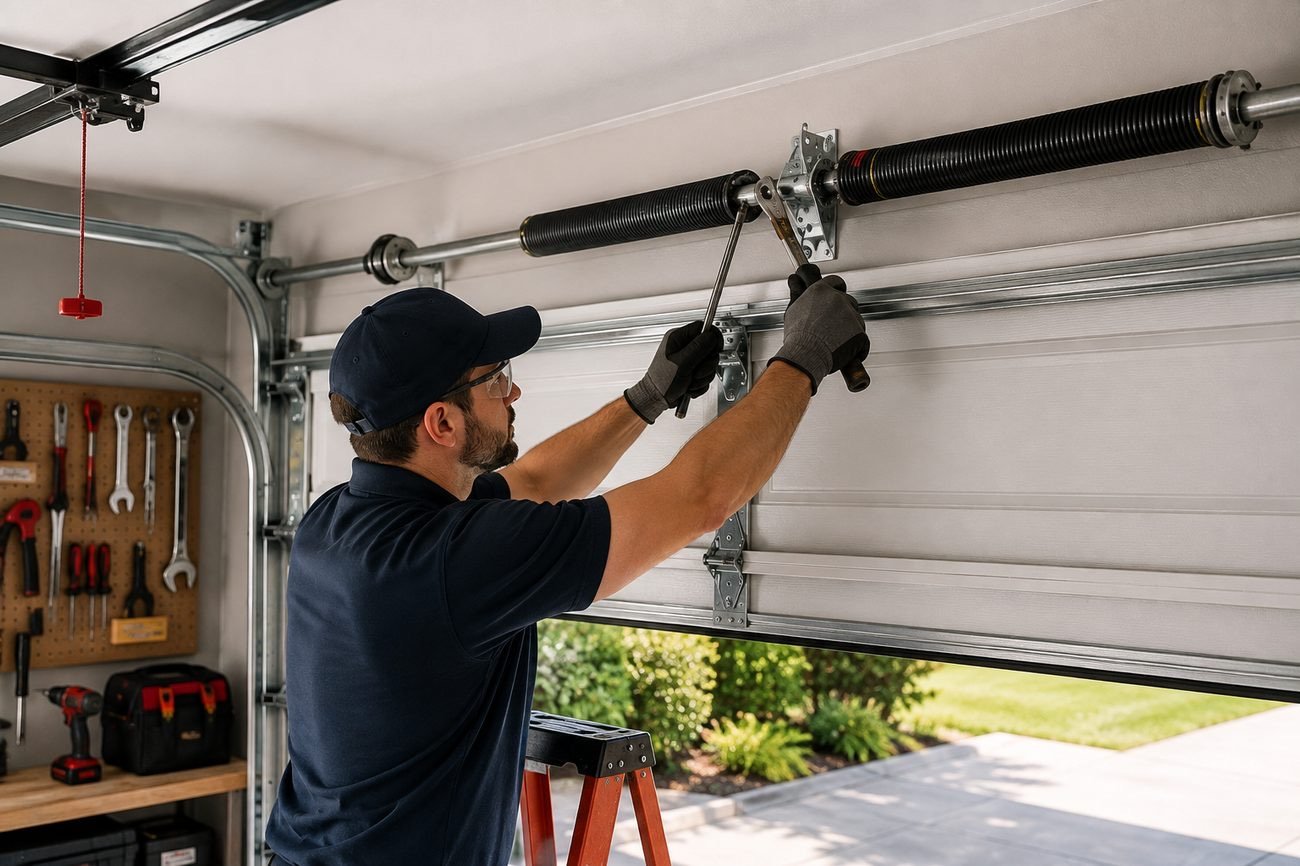
When we arrive, we'll first inspect the entire door system—not just the broken spring. A snapped spring can put stress on cables, drums, and bearings. Here's what a typical spring replacement looks like:
- Safety check. We secure the door and make sure the area is safe.
- Measure and match. We identify the correct spring size and wire gauge for your door's weight.
- Replace the spring(s). Using proper winding bars, we remove the old spring and install the new one, carefully winding it to the correct tension.
- Inspect related parts. We check cables, rollers, hinges, and the opener for wear or damage.
- Test and balance. We run the door several times to ensure it's balanced, quiet, and safe.
- Clean up. We remove the old parts and leave your garage tidy.
We back our repair work with a 1-year warranty. If you'd like to see examples of our work, visit our gallery.
How to Prevent the Next Loud Bang
Springs don't last forever. Most torsion springs are rated for about 10,000 cycles—one cycle is one open and one close. If you use your door four times a day, that's roughly seven years. Many springs fail sooner due to rust, poor lubrication, or an unbalanced door.
You can't stop a spring from breaking eventually, but you can extend its life and catch problems early:
- Lubricate moving parts. Use a silicone-based lubricant on hinges, rollers, and the spring itself once or twice a year. Don't use WD-40 on springs—it attracts dirt.
- Listen for changes. A door that suddenly gets noisy or jerky may have a worn spring or cable.
- Schedule a tune-up. A professional tune-up includes checking spring tension, balance, and all hardware. Our Maintenance & Tune-Ups start at $99 and can catch a failing spring before it snaps.
- Watch for rust. In Northeast Ohio, road salt and humidity can rust springs. A rusty spring is more likely to break.
- Don't ignore a gap. If you see a gap in the spring coil, it's broken. Call for service.
If your door is older and you've already replaced springs once, it might be worth considering a garage door replacement or at least a full system check. We're happy to advise.
When to Call for Help
Any time you hear that loud bang and the door stops working, it's time to call. Don't wait—a door with a broken spring is unsafe, and using it can cause more damage. Red Oak Garage Door Service and Repair LLC is family-owned and based in Garfield Heights. We serve Cleveland and the surrounding suburbs with prompt, professional service.
We're licensed and insured, and we have a 4.9-star average from 127+ local reviews. Our hours are Monday–Friday 7am–7pm, Saturday 8am–5pm, with a 24/7 emergency line. Call us at (216) 395-1738 or email info@redoakgaragedoor.com. You can also contact us online or request a free quote.
FAQ
Can I replace a garage door spring myself?
We strongly advise against it. Torsion springs are under extreme tension and require specialized tools and training. Improper adjustment can cause serious injury or damage. It's a job for a licensed technician.
How much does spring replacement cost?
Torsion spring replacement typically ranges from $250 to $450, depending on the spring type and door size. We'll give you a clear price before any work begins.
My door is stuck open—can you help after hours?
Yes. We have a 24/7 emergency line for situations like this. Call (216) 395-1738 and we'll dispatch help as soon as possible. We don't guarantee a specific arrival time, but we prioritize emergency calls.
Will my homeowner's insurance cover a broken spring?
Most homeowner's policies don't cover mechanical wear and tear, which is what a broken spring usually is. Check your policy or ask your agent. We can provide a detailed invoice for your records.
How long do garage door springs last?
Most springs last 7–10 years with normal use, but factors like rust, lack of lubrication, and an unbalanced door can shorten that. Regular tune-ups help you catch wear early.