
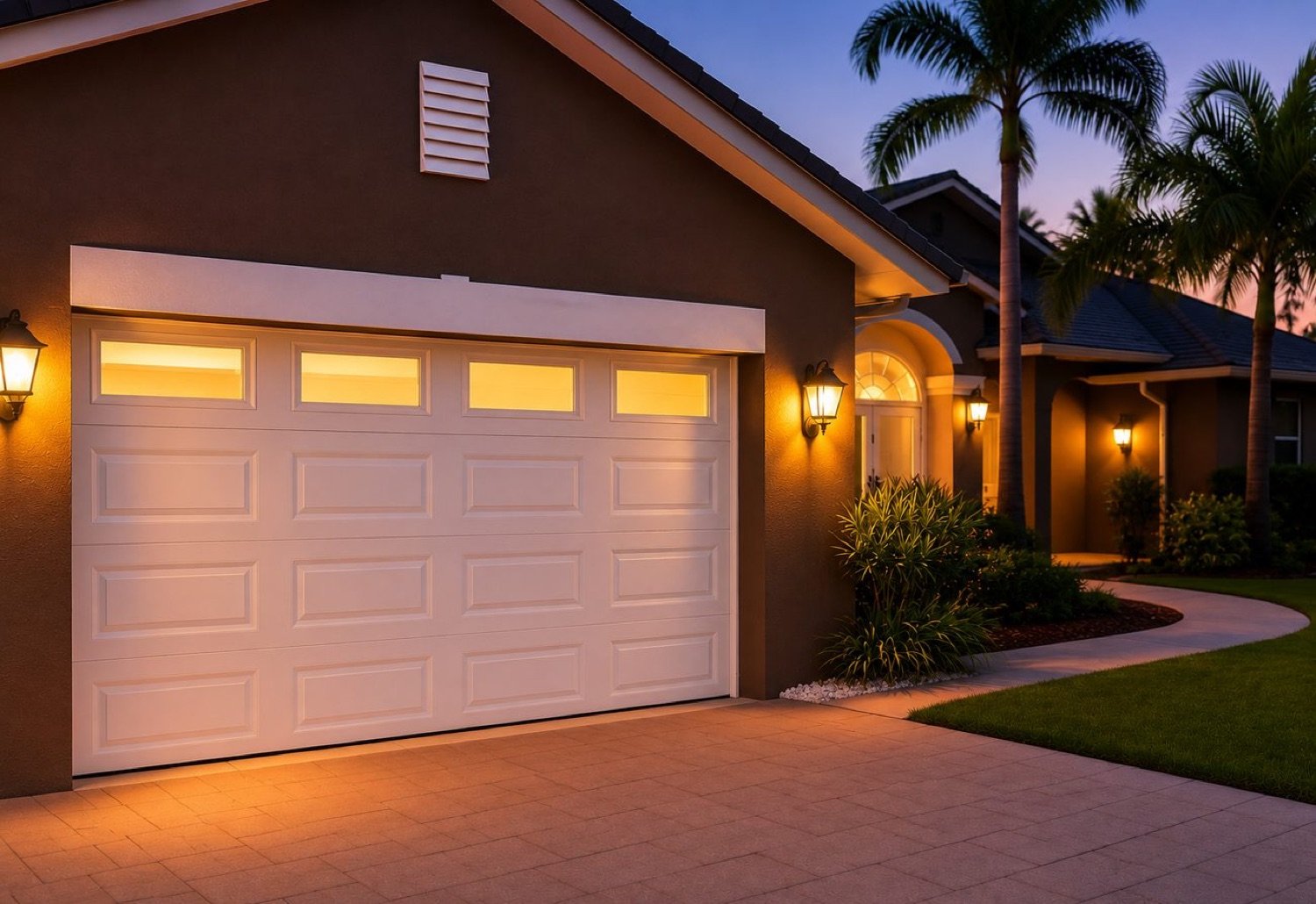
Why This Decision Matters in Greater Cleveland
If you live in Garfield Heights, Parma, Bedford, or anywhere else in Greater Cleveland, your garage door is the largest moving object on your house. It is also the thinnest wall in most homes. A single-car steel door is often just two sheets of steel with air between them. A double-car door has roughly the same surface area as a small bedroom wall. When the temperature drops into the teens and twenties for weeks at a time, that uninsulated panel becomes a cold radiator that pulls heat out of the rooms next to it.
An insulated garage door changes that. It adds a foam or polystyrene core between the steel skins, which slows heat transfer and stiffens the door. But insulation is not automatically worth the money for every homeowner. The right choice depends on where the garage sits, which way the door faces, and how you use the space. Here is how to think it through like a technician instead of a salesperson.
What R-Value Actually Measures
R-value is a measure of thermal resistance. The higher the number, the better the material stops heat from moving through it. R-value is stated per inch of thickness, but garage door manufacturers list the whole-door R-value, which accounts for the panels, the frame, the seams, and the hardware that cuts through the insulation.
For reference, here is how common garage door constructions stack up:
| Door type | Typical whole-door R-value | What it means in an Ohio winter |
|---|---|---|
| Uninsulated single-layer steel | R-0 to R-2 | Cold to the touch, condensation forms, heat escapes fast |
| Steel with a thin vinyl or foam backer | R-4 to R-6 | Better, but seams and gaps still leak |
| Steel with a bonded polyurethane core | R-9 to R-12 | Solid, quiet, and warm enough for a workshop |
| Premium polyurethane, full frame | R-13 to R-18 | Best for attached garages and heated rooms above |
Two things matter as much as the number on the sticker. First, the door has to be installed with tight perimeter seals and a proper bottom weatherstrip. A high-R door with a worn bottom seal leaks air and loses much of its advantage. Second, the R-value of the door only helps if the rest of the garage is reasonably sealed. An attached garage with an open attic hatch or unsealed rim joist will still be cold no matter what door you hang.
Fast local service across Garfield Heights and Greater Cleveland — free written estimate before any work.
Why a West-Facing Door Can Heat the Whole House
This is the part most homeowners do not expect. In Northeast Ohio, the afternoon sun in fall and winter hits west-facing surfaces hard. If your garage door faces west, it absorbs that solar gain. An uninsulated steel door heats up quickly, then radiates that heat into the garage and through the shared wall into the house. On a sunny 35-degree afternoon, a west-facing garage can climb well above the outdoor temperature while the rest of the house is comfortable.
The result is a swing: the rooms next to the garage get warm, your thermostat backs off, and then the sun drops and the garage cools fast. The furnace has to catch up. You feel it as rooms that are never quite steady. An insulated door slows both directions of that transfer. It resists the afternoon heat gain and holds what warmth is in the garage overnight. The house feels more even, and the furnace is not chasing a garage that acts like a greenhouse at 2 p.m. and an icebox at 2 a.m.
West-facing is not the only factor. South-facing doors get similar treatment. But west-facing is the one we hear about most from customers in Brook Park, North Royalton, and the west side of Cleveland, because the afternoon sun is strongest when the house is already warmed up.
When Insulation Pays for Itself
Insulation is not free, and we will not pretend it is. A basic single-car steel door installed runs roughly $1,200 to $2,500, and a double-car door runs $1,800 to $5,000. Insulated models sit toward the upper end of those ranges. Whether that extra cost pays you back depends on your situation.
It usually pays for itself when:
- The garage is attached and shares a wall or ceiling with living space. Heat loss through that shared wall is real, and a better door reduces it.
- You have a room above the garage. That floor stays colder than the rest of the house unless the garage below is moderated.
- The door faces west or south and gets direct afternoon sun. You get comfort benefit in both summer and winter.
- You use the garage as a workshop, gym, or hangout space. Insulation makes it usable for more of the year.
- You plan to stay in the home for years. The savings are gradual, not instant.
It is less of a priority when the garage is detached and unheated, when the door is on a shed or storage building, or when the existing door is in good shape and the budget is tight. In those cases, spending on seals, a tune-up, and weatherstripping may be the better first move. If you are not sure, a free quote request through our quote form is a no-pressure way to get a straight answer for your address.
Other Reasons Insulated Doors Win in Ohio
Thermal performance gets the attention, but insulation changes how the door behaves day to day.
- Quieter operation. The foam core damps vibration. A double-layer door is noticeably quieter than a single-layer steel door, especially on an attached garage under a bedroom.
- Less condensation. A cold steel panel sweats when warm, moist air hits it. That moisture rusts hinges, rollers, and the bottom of the door. Insulation keeps the interior surface closer to room temperature.
- Stiffer panels. The core adds rigidity, so the door is less likely to dent or bow. That matters on wide double doors.
- Better resale talking point. Buyers in Northeast Ohio notice a solid, quiet, insulated door.
If your current door is dented, rusted along the bottom, or has a broken panel, replacing it with an insulated model is often the cleaner path than repairing a door that was never going to hold heat. You can see examples of what we install on our gallery page.
What to Check Before You Buy
Before you choose a door, walk out and look at the whole opening, not just the panels.
- Measure the opening and the headroom. Insulated doors are thicker, usually 2 inches instead of 1 3/8 inches. That can affect track and opener clearance. A proper measurement avoids surprises.
- Check the bottom seal and side jambs. If the seal is cracked or the jambs are gaps, fix those first. Insulation cannot help a door that leaks air.
- Look at the opener. A heavier insulated door may need a stronger opener or a different spring setup. If yours is old or straining, plan for it. Our opener service covers that.
- Ask about the whole-door R-value, not the panel R-value. A sales sheet that quotes R-18 for the foam but R-9 for the assembled door is telling you two different things.
- Confirm the warranty in writing. We provide a 5-year workmanship warranty on installations and a 1-year warranty on repairs.
If your existing door is sticking, noisy, or not sealing, a maintenance and tune-up can buy you time while you decide on replacement. Tune-ups start at $99, and torsion spring replacement runs $250 to $450 if that is what your door needs.
How Red Oak Handles It
Red Oak Garage Door Service and Repair LLC is family-owned and has been working on Greater Cleveland doors since 2009. We are based in Garfield Heights and serve Cleveland, Parma, Shaker Heights, Solon, Westlake, Strongsville, and the towns listed on our service area page. We measure, we explain the R-value and the seals in plain terms, and we tell you when insulation is not worth it for your garage. If a door fails in the cold, our 24/7 emergency line is available and we schedule the earliest available appointment. For installation or replacement questions, call (216) 395-1738 or email info@redoakgaragedoor.com.
FAQ
Is an insulated garage door worth it in Ohio?
For an attached garage that shares a wall or ceiling with living space, usually yes. It reduces heat loss, cuts condensation, and makes the garage quieter. For a detached, unheated garage, the comfort benefit is smaller and the payback is slower.
What R-value should I look for?
For an attached garage in Northeast Ohio, aim for a whole-door R-value of at least R-9, and R-13 or higher if there is a room above the garage. Be sure the number is for the assembled door, not just the foam core.
Will an insulated door stop my west-facing garage from getting hot?
It will slow the heat gain and make the temperature swing smaller, but no door eliminates solar gain entirely. Combined with tight seals and a shaded or ventilated garage, the difference is noticeable in the rooms next to the garage.
Can I insulate my existing door instead of replacing it?
Sometimes. Foam board kits can be added to some single-layer steel doors, but they do not fix a bent track, worn rollers, or a failing spring, and they do not give you the stiffness of a factory-insulated door. We can look at your door and tell you which makes sense.
How long does installation take?
A standard residential door replacement is typically a few hours for a two-person crew, depending on the door size, track condition, and opener setup. We confirm the window when we schedule, and we do not promise a specific arrival time.