
The Bang You Just Heard
It's a sound homeowners in Red Oak don't forget: a sharp, echoing bang from the garage, followed by a door that suddenly won't open. That bang is almost always a garage door spring breaking. The spring is under extreme tension, and when it fails, the energy releases all at once. The door may drop a few inches and stay there, or the opener may strain and hum without moving anything.
If this just happened to you, the first thing to know is that garage door spring replacement is a normal, well-understood repair. The second thing is that it is not a do-it-yourself job. Springs are the most dangerous component on the entire door system, and they are the reason professionals exist. Below, we'll walk through what broke, why it's dangerous, how torsion and extension springs differ, and what a same-day service visit looks like.
Why the Spring Breaks (and Why It Sounds Like a Gunshot)
A garage door is heavy. A single-car steel door can weigh 150 pounds or more; a double-car door can top 300 pounds. The springs are what make that weight manageable for the opener and for you. They store energy as the door closes and release it as the door opens, doing most of the lifting work.
Every open-and-close cycle puts wear on the spring. Over years of daily use, the metal fatigues and eventually cracks. When it lets go, the tension releases in a fraction of a second, which is why it sounds like a bang or a pop. You may find a gap in the coil, a piece of spring on the floor, or a door that feels unusually heavy when you try to lift it by hand.
In North Texas, heat and temperature swings also play a role. A garage that bakes at 110°F in July and cools off in winter puts extra stress on metal parts. Springs don't last forever, and a break is not a sign that you did something wrong. It's a wear item reaching the end of its service life.
Same-day service across Red Oak and Ellis County — free written estimate before any work.
Why You Should Not Touch a Broken Spring
This is the most important section in this article. A torsion spring is wound tight and held in place by set screws and winding bars. An extension spring is stretched along the tracks. Both are under enough tension to cause serious injury if released incorrectly. Homeowners have lost fingers and suffered deep lacerations trying to "just take a look" or replace a spring with hardware-store parts.
There are also secondary risks. When a spring breaks, the door can come down unevenly, cables can jump their drums, and the opener can strip its gears trying to lift a door that no longer has spring assistance. A door that is hanging by one cable is not something to operate, even manually.
If you heard the bang, stop using the door. Leave it closed if it's closed, and leave it open if it's open. Don't force it, and don't let anyone stand under it.
Professional technicians use proper winding bars, control the tension safely, and inspect the cables, drums, and bearings while they're in there. That's not upselling; it's how you avoid a second failure two weeks later. If you need help now, our 24/7 emergency repair line is staffed around the clock.
Torsion vs. Extension Springs: What Replacement Involves
Most homes in Ellis County have one of two spring setups. The repair process is different for each, and so is the time and cost.
Torsion springs
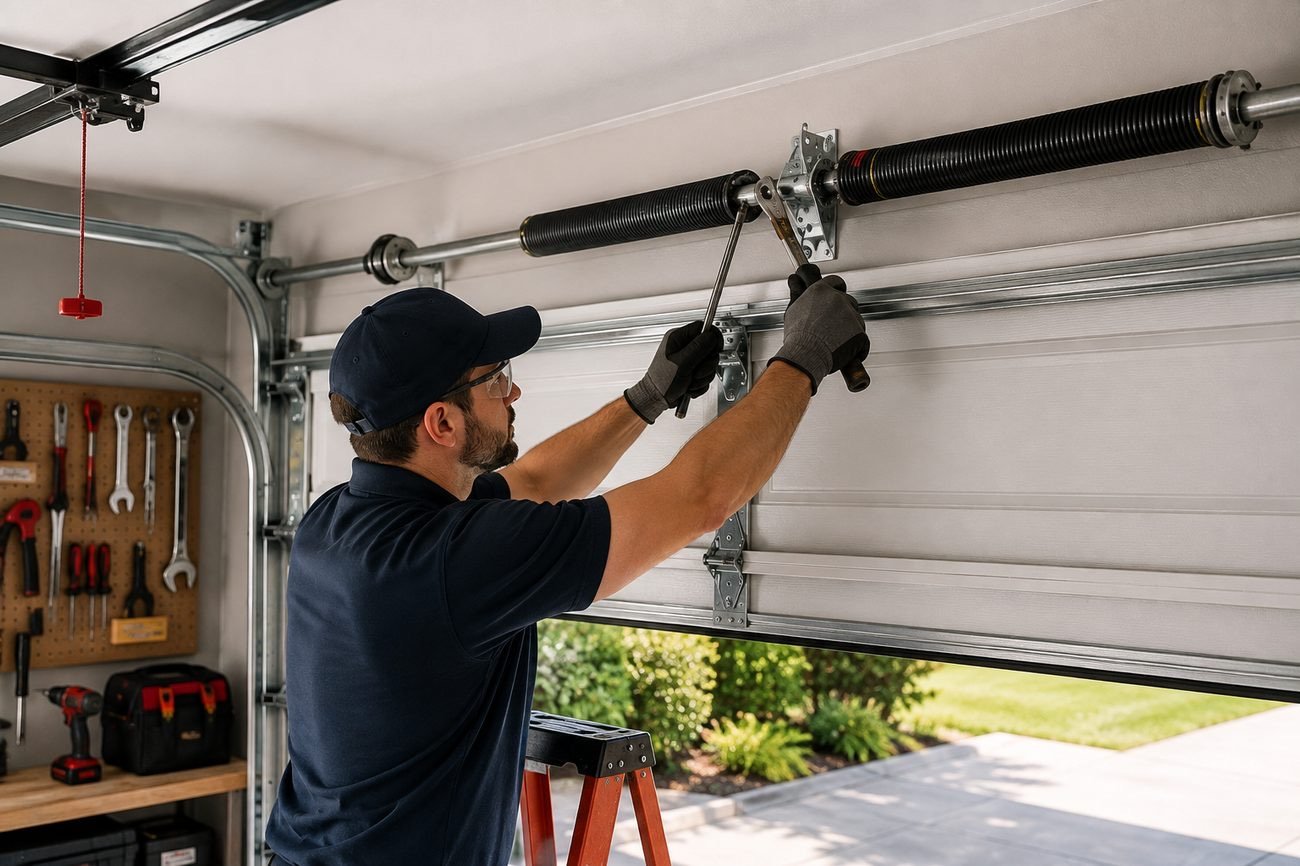
Torsion springs are mounted on a metal shaft above the door, usually parallel to the header. They twist rather than stretch. Replacing one means winding down the remaining tension (if any), removing the old spring, measuring the wire size and inside diameter, installing the new spring, and winding it back to the correct number of turns. It's precise work. A torsion spring replacement typically runs $250–$450 depending on the door and spring type.
Extension springs
Extension springs run along the horizontal tracks on either side of the door and stretch as the door closes. They're common on older or lighter doors. Replacement involves relieving tension, disconnecting the spring and safety cable, installing the new spring, and checking that both sides are balanced. Extension springs should always have safety cables running through them so that if they break, the spring doesn't fly across the garage.
- Never replace just one spring on a two-spring door. If one broke, the other has the same number of cycles on it and is likely close behind.
- Match the spring to the door. Wire gauge, inside diameter, and length all matter. The wrong spring can overload the opener or leave the door unbalanced.
- Check the cables and drums while the spring is off. Frayed cables are a common companion failure.
If your door is older and you're facing repeated spring repairs, it may be worth talking through garage door replacement versus another round of repairs. We'll give you a straight answer either way.
How a Same-Day Visit Works
Spring failures are urgent because the door is your main entry and your car is trapped. We treat them as priority calls. Here's what the process looks like when you call us.
- You call (972) 555-0147. Tell us what you heard, whether the door is open or closed, and the rough age of the door if you know it. We'll ask a few questions to figure out whether it's a torsion or extension setup.
- We schedule the soonest available window. Same-day service is available where scheduling allows. We won't promise a specific arrival time we can't keep, but we'll give you a realistic window and call ahead.
- The technician inspects the full system. That means the springs, cables, drums, rollers, hinges, and the opener. A broken spring can damage other parts on the way out.
- You get a clear quote before work starts. No surprise charges. If we find something else that needs attention, you'll see it and decide.
- We replace the spring and test the door. Balance, travel limits, and safety reverse are all checked before we leave. Repairs carry a 1-year warranty.
Most spring replacements are completed in a single visit. If a specialty spring has to be ordered, we'll tell you up front and secure the door so it can't be operated in the meantime.
If you're not sure whether you need emergency service or can wait for a regular appointment, call and ask. We'd rather answer a question than have you get hurt.
What It Costs and How to Avoid the Next Break
For budgeting, torsion spring replacement runs $250–$450. Extension spring replacement is usually in a similar range, though the exact figure depends on the door and hardware. That's the repair cost; it doesn't include unrelated parts like cables or rollers if they also need attention.
Once the new spring is in, a little maintenance goes a long way. Lubricate the springs, hinges, and rollers a couple of times a year. Have the door balanced and inspected annually. Listen for grinding or popping sounds and address them early. Our maintenance and tune-up service starts at $99 and catches worn parts before they fail at 7 a.m. on a workday.
If you're in Red Oak, Waxahachie, Lancaster, Cedar Hill, Duncanville, DeSoto, Midlothian, Ennis, Ovilla, Glenn Heights, Ferris, Palmer, Maypearl, or Italy, we're nearby. You can see our service area for the full list of towns, or request a free quote online.
One last note: if your door is stuck open and you can't secure the house, call us right away. A door that's stuck open is a security problem as well as a mechanical one.
FAQ
Can I open my garage door by hand after a spring breaks?
No. A door with a broken spring is extremely heavy and can come down suddenly. Even if you can lift it, the risk of injury and damage to the door and opener isn't worth it. Leave it alone and call for service.
How long does garage door spring replacement take?
Most torsion and extension spring replacements are completed in one visit, often within a couple of hours depending on the door and what else needs attention. If a specialty spring has to be ordered, we'll let you know and secure the door in the meantime.
Do I need to replace both springs if only one broke?
On a two-spring door, yes, in almost every case. Both springs have the same cycle count, so the second one is usually close to failing. Replacing one now often means paying for a second service call soon after.
Is a broken spring covered by my homeowner's insurance?
Usually not. Most policies treat spring failure as normal wear and tear. Check your policy or ask your agent, but plan on paying for the repair out of pocket.
Can you come out today?
We offer same-day service where scheduling allows and maintain a 24/7 emergency line. Call (972) 555-0147 and we'll give you the soonest realistic window.